Tuesday, April 17, 2018

BAUR TC3

The BAUR TC3, designed by ISDERA (Their Commendatore 112i being one of my all time favorite cars) for BAUR, based on an E30 BMW. The project was stopped by BMW because of their own upcoming Z1 project. So this is number one of one.


Sunday, April 15, 2018

Th Jaguar E-Type is the on car Enzo Ferrari said was the most beautiful car ever made. Going above and beyond that are the people from Eagle...the cars they turn out are absolutely stunning. And the Eagle Speedster is probably the most stunning of them all! If I won the lottery tomorrow I know where Id be headed...


Thats some skills right there! Both on the bikrs side aaand the photographers!


Bizzarrini GT 1971

In an of themselves Bizzarrinis are already pretty unique cars. Not a lot were made when the factory was up and running, but this particular GT is even more unique as it was built long after the factory closed down. On top of that it uses a Lamborghini V12 instead of the usual Chevrolet V8s that were used previously.

This car was built by an ex Bizzarrini worker Giancarlo Riali using a Lamborghini 400GT/Jarama chassis. The body was left over after the Bizzarrini factory shut down and so Mr Riali used it to rebody the Jarama.

Its quite an interesting what if...a period body on a period chassis from a direct competitor. Makes one wonder what either company could have done, Lamborghini styling wise, and Bizzarrini engine and suspension wise.


Maserati Shamal Spyder by OPAC 1992

Unique and a one-off prototype of the Maserati Spyder. This car was intended as a successor of the 1980s Maserati Biturbo Spyder. It was first presented in 1994 at the motor show in Turin. In the beginning of 2000 this car ended up in the hands of a Dutch collector which has maintained the car perfectly. It was also regularly driven. Biturbo V8 engine is connected to a 5 speed gearbox. Technical specifications are identical to the Shamal. The manufacturer OPAC has also built a hardtop to make it complete.


Sunday, February 7, 2016

Lamborghini LM004 7000

The idea of a multi-purpose Lamborghini was taken one step further with the enormous LM-004. The car was built around the same chassis as the LMA-002, but went much further, the engine wasn't the 'normal' 4754 cc unit (factory designation number L 503), but an all new 7.0-Litre one. This new engine was designed by Alfrieri and used very little parts from the original 5-Litre unit, this 7-Litre unit was actually destined for marine purposes and could be distinguished from the smaller V-12's by the larger exterior dimensions and the design of the cam cover. Several other parts around the engine were changed too, the gearbox became mechanical instead of the automatic ones in the first designs, and a special design by ZF was used, taken from the LMA-002. The suspension was also taken from the LMA, as was the power-assisted steering, but a big difference was the use of drum brakes on the rear axle.

Lamborghini aimed the LM-004 at another category of customers, this was clearly visible on the inside of this car, the seats were changed for body-hugging types like those in the Countach, upholstered in leather, with nice carpets on the floor, a complete dashboard with radio-telephone, VHF radio, stereo system, air-conditioning, refrigerator and a cold-water tap between the back seats.
All this made the LM-004 appear like a giant, upright Countach, and this large, 3000 Kg heavy beast could even reach 200 Km/h.

Only one LM-004 was built, the new 7-Litre engine did not perform well enough to allow the increase of weight against a 5-Litre unit. Therefore, further testing was done with the 5-Litre unit, resulting in the LM-002, which would be commercialized from 1986 on, in almost the same form as the LM-004.
Note that the original LM004/7000 was actually tested by AutoCar in May 1986, perhaps you can still find a copy of this test, unfortunately this rare Lamborghini no longer exists today.
Rumors state however that it was possible to order the LM002 with the 7.0-Litre Lamborghini marine engine fitted into it, naturally on special demand for a wealthy customer, prices for this 'option' were never published, but then again, anyone who would order it with this massive engine wouldn't care about a little extra cost.


VW streamline prototype

Based on the KdF-Wagen Typ 60, aka VW Beetle, it was designed by K.C. Volkhart as a fast courier car for Luftwaffe (German Air Force). Body, designed by Baron Reinhard von Koenig-Fachsenfeld, was built by Helmut Fuchs Niederwenningern/Ruhr. Thanks to its low drag coefficient (0.17 only) the streamline body allowed for speeds up to 150 km/h. The engine, mounted at the rear, was the standard VW 1.1-liter boxer, 24.5 hp.


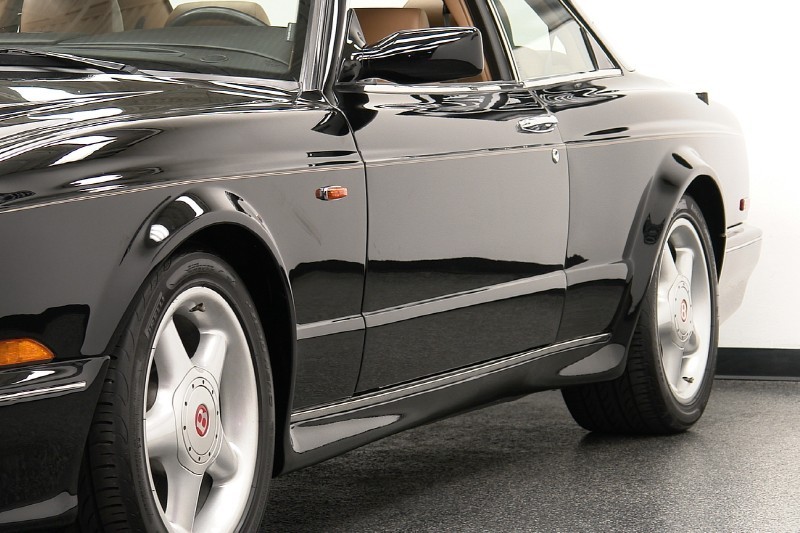
Bentley Continental T

One of my all time favorite cars! I have just always really loved the muscle car looks combined with the Bentley refinement. The T version had a shorter wheelbase, and wider fenders compared to the regular versions of the Continental. Considering it has a GM 4L80-E it would be interesting to see what a swap to a 6 speed 6L80-E would give performancewise (and fuel savings wise). One odd thing about these is that they have two brake calipers in the front. Would be interesting to know the reasoning behind that...


Thursday, December 12, 2013

Lamborghini LM003 Borneo

During the ownership of Automobili Lamborghini SpA by the Indonesian group, a study was made to put a LM002 replacement into production.

The LM002 obviously had flaws but it still was a steady low volume seller, therefore a United Kingdom based company was contacted to design a successor to the LM002, but later this job was handed over to SZ Design, a company based on the remains of the Zagato Design Studio.
This was to become the LM003, named Borneo or Galileo, depending on what market it was sold in. The LM003 name was actually confusing because an LM003 did already exist in the past, it was in fact an LM002 with a Turbocharged Diesel engine installed into it instead of the massive V12, but because the complete car was very underpowered with this engine configuration only one prototype was ever made and never left the factory.

A preliminary drawing was made for the new LM003 project, but an in depth market research study revealed only a small interest would exist in the new LM003. Most Lamborghini customers or future customers were not exactly waiting for a new off roader, a much more wanted car would have been an Espada successor like the L149 project or a new Diablo successor. For that reason the Borneo/Galileo never even made it into the prototype stage. A few drawings by Zagato exist, together with some technical proposals, with which a full scale mock up was created.

The new LM003 Borneo would become a joint venture between Timor, and Indonesian based automaker and Lamborghini. The body shell would not be made in Italy but in the Far East. The LM002 bodywork was in fact made in Spain when it was still in production.


The rumors persist that a new Lamborghini SUV will be produced, and if its anything like the concept that was show it will look amazing! I guess we will have to wait and see...


Friday, November 1, 2013

Lamborghini LM002 Paris Dakar

It was made quite clear right from the start Ferruccio Lamborghini had absolutely no intention in taking any of his cars racing, he didn't want to spend money on preparing a competition model. There were some private teams that used cars like the Islero and Miura on the track, but with no official factory support.

When Ferruccio had left the car company and after several owners stepped in it was time for a new, young approach … and under the Mimran ownership period the first official attempt at using a Lamborghini as a race car … or more exactly a rally car. In the mid-Eighties it was deemed the right time had come to enter the notorious Paris Dakar rally using the four-wheel drive LM002.

Work began on chassis number HLA12047 to convert this regular 455hp V12 Lamborghini into a rally specs edition pumping out over 600hp so an open race exhaust was installed and a lot of excess weight was removed from the standard LM002 by the usual rally car methods of stripping the interior of any needless luxury, replacing the glass with lighter Plexiglas, and adding a full roll cage. Naturally the suspension was also upgraded to cope with high-speed desert driving.

Lamborghini managed to get none other than rally legend Sandro Munari to drive this factory prepared LM002 Rally edition. Unfortunately it was never actually driven in a Paris Dakar Rally, it was entered in the Rally of the Pharaohs in 1987 (October 18-28) but didn't start the race after the sponsor had a deadly accident in an offshore powerboat.

The LM002 Rally re-appeared in the 1988 off-road rally in Greece, when Mario Mannucci was the driver with Sandro Munari as the co-pilot, sadly the Lamborghini didn't finish the rally, but it did manage to hold the third position at first. After this short life in competition it is believed the engine was replaced by a more 'standard' V-12 and the car was sold to a collector … however recent information mentions LM002 number HLA12047 is back to full factory rally specs … and still part of a Lamborghini collection.

Even though the factory original LM002 Rally didn't make it into the Paris Dakar in 1988 a LM002 WAS entered by a privateer. The Swiss based World LM Racing Team entered a bright red LM002 in the grueling Paris Dakar competition, and while some sources state they had to retire the race, other sources list this car with starting number 519 did actually finish in 10th position in the Marathon category. This red LM002 was driven by Concet and Kurzen, P.A. Burnier was the owner of the World LM Racing Team while Maregrande from the Lamborghini factory was appointed as the designated mechanic and none other than Sandra Munari was a technical advisor on this car … so while not an official factory entry into the Paris Dakar it still had some direct linkage to Sant'Agata.
Some specs on this 1988 LM002 Rallye (they called it Rallye instead of Rally): 5200cc V12 engine, 475hp, 3200kg in full rally load, 600 lite fuel tank with a fuel consumption of 68 Liter/100km … resulting in about 900km on a full tank while reaching speeds of up to 200km/h on the street and an impressive 180km/h in the sand.

Another LM002 was prepared for the Paris Dakar rally by a private party. This orange finished LM002 was once again factory build, finished in bright orange over black. It was later sold to a Japanese collector who, according to the Lamborghini Registry, still drives it with the original open exhaust system today.

In 1996 another heavily modified LM002 with chassis number HMA12046 was entered in the Prototype category. Rumor has it Garage Burnier in Switzerland took on the work of converting this LM002, the engine was taken out of the car and received a custom fuel injection system, the factory standard catalyst were removed and both cooling and lubrication were modified and reinforced so the car would be able to withstand desert racing. The front brakes were replaced by AP units and a massive 800 liter fuel tank was mounted to increase the range. when completed chassis number HLA12046 was officially entered into the 1996 Dakar race and received number 246. At first it kept up with the competition very nicely, but unfortunately the weight of the LM002 and the use of using shock absorbers that were not heavy duty enough together with the high speed desert driving took their toll on the suspension. In a matter of days the team went through no less than 24 shock absorbers … and had to forfeit the race due to a lack of spare parts.

Would have been interesting to see what proper desert racing shocks would have allowed this LM to accomplish...